
Missed emergency incident review
A post-incident review template for the night an after-hours maintenance emergency was missed, answered late or sent to the wrong person: a timeline built from records, what contributed, the effect, and the changes with an owner and a date. Download it as a Word or PDF file.
A missed emergency can cost a unit, a resident’s trust and more. This review walks the call from the first ring to the technician on site, finds the step that failed, and turns it into a change someone owns. It looks for contributing factors and corrective actions rather than someone to blame, which makes it easier for people to say what actually happened, including a phone left on silent.
Free to adapt for your community. No email address required. Version 2026-09-26. See all templates.
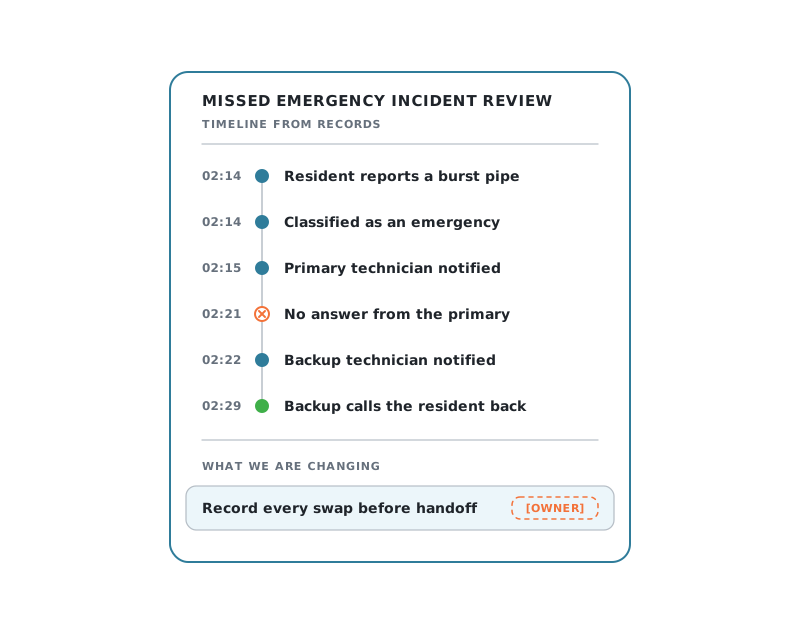
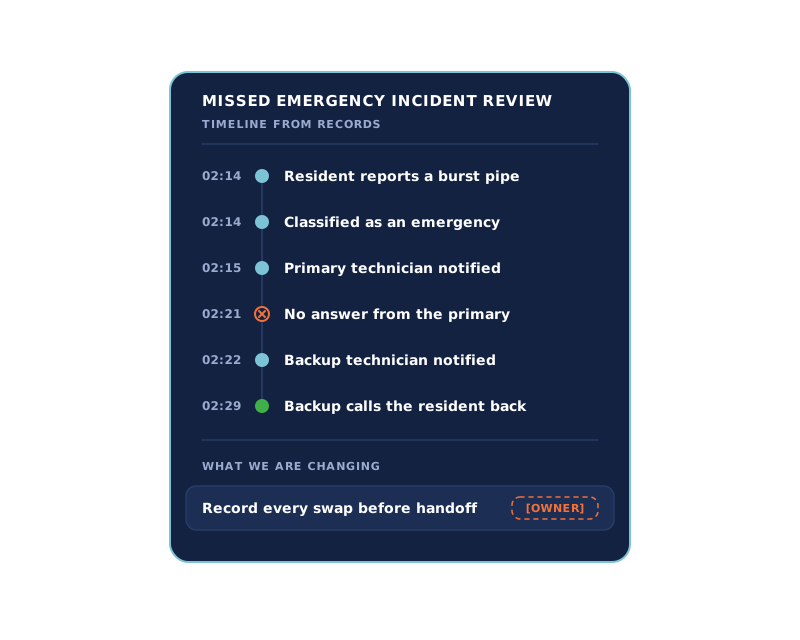
Nine sections, from the first call to the sign-off.
Anything in [SQUARE BRACKETS] is yours to fill in. Build the timeline in section 2 from records before anyone writes section 5, so the contributing factors come from what the records show.
-
1
What happened
Date [DATE]. Community and unit [COMMUNITY, UNIT]. What the resident reported, in their words: [DESCRIPTION]. What it turned out to be: [DIAGNOSIS]. Outcome [RESOLVED ON (DATE, TIME) / STILL OPEN]; work still to do [NONE / DETAIL], owned by [NAME].
-
2
Timeline
Build it from records, not memory: the call recording and report, the notification log, phone records and the work order. Add a row for every attempt, including the ones nobody answered.
Time What happened Source [TIME] Resident first calls [CALL RECORD] [TIME] Call classified as [EMERGENCY / NOT AN EMERGENCY] [CALL RECORD] [TIME] First notification to [NAME] [NOTIFICATION LOG] [TIME] [ANSWERED / NO ANSWER / ESCALATED TO (NAME)] [NOTIFICATION LOG] [TIME] Technician calls the resident back [PHONE RECORD] [TIME] Hazard made safe [WATER OFF / POWER OFF / AREA SECURED] [TECHNICIAN] [TIME] Technician on site [WORK ORDER / TECHNICIAN] -
3
Was it recognized as an emergency
[YES / NO]. If not: did the written criteria cover it [YES / NO / UNCLEAR], did the caller describe it in a way the criteria missed, or did the call take a path meant for something else? Quote the criteria as they stood that night: [TEXT].
-
4
Did the right person hear about it in time
Who was on the schedule [NAME], and was the schedule current [YES / NO, BECAUSE]. How long from the first call to the first notification [MINUTES], and to the technician's callback to the resident [MINUTES], against the target of [MINUTES]. If escalation ran, did each step happen as the call order says [YES / NO, BECAUSE].
-
5
What contributed
Mark everything that applies, then explain each: [ ] criteria unclear or silent, [ ] schedule out of date or swap not recorded, [ ] phone off, silenced or out of range, [ ] a number missing or wrong, [ ] vendor unavailable, [ ] language or description, [ ] something else: [DETAIL].
-
6
The effect
On the resident: [DESCRIPTION]. On the unit and building: [DAMAGE]. Estimated cost [AMOUNT]. Anyone hurt or at risk [NO / DETAIL]. Other units affected [NONE / WHICH].
-
7
What we are changing
One row per change, each with an owner and a date.
Change Owner Due Done [CHANGE TO CRITERIA, SCHEDULE, CALL ORDER OR NUMBERS] [NAME] [DATE] [ ] [CHANGE] [NAME] [DATE] [ ] -
8
Following up with the resident
[NAME] spoke with the resident on [DATE] about what happened and what is changing. Anything offered: [NONE / DETAIL, APPROVED BY ROLE].
-
9
Sign-off
Reviewed by [NAMES] on [DATE]. Shared with [MAINTENANCE TEAM / REGIONAL MANAGER / ANSWERING SERVICE]. [ROLE] checks on [DATE] that every change in section 7 is done.
The short version to share once it is signed off.
The full review goes to the people who took part and those named in section 9. The rest of the maintenance team needs what happened, what changes, and the one thing to do differently on their next week on call.
On [DATE], an emergency at [UNIT], [DESCRIPTION], [WAS MISSED / WAS ANSWERED LATE / WENT TO THE WRONG PERSON]. The main reason was [REASON]; the review looked at what contributed, not at blame. What changes, from [DATE]: [CHANGES]. If you are on call, the one thing to do differently is [INSTRUCTION]. Questions go to [ROLE].
Where to look for the answers.
The written criteria. Section 3 quotes the emergency rules as they stood that night. If there were none written down, that is the finding, and our after-hours maintenance policy template is a place to start.
The schedule that night. Section 4 asks whether the schedule was current. An unrecorded swap or a sick day nobody entered shows up here, and our on-call schedule template has rules for both.
What the service was told. A missing vendor number or an out-of-date call order is a handover gap. The answering service setup worksheet lists everything a service needs and who keeps it current.
How many calls reach the line. It helps to know what normal looks like. Our figures on how many after-hours calls are real emergencies show where calls to an emergency line end up.
With Activ, the record is already there.
The call record Activ keeps includes the recording and a transcript, in English or Spanish, so section 2 can start from the caller’s own words. The on-call technician is notified within 30 seconds of the end of an emergency call, by push, automated voice call and email. Each person on the schedule gets three calls, with a text on the third, before Activ moves to the next, and if the whole list is exhausted a high-importance email goes to everyone subscribed to those calls.
How that works day to day is on our maintenance dispatch and on-call scheduling pages.
Common questions about incident reviews.
- What is a post-incident review for a missed maintenance emergency?
- A short written account, made after the fact, of an after-hours emergency that was missed, answered late or sent to the wrong person: what happened, minute by minute, why, and what will change. The aim is to fix the rule, schedule or number that failed, so the same call goes right next time.
- Who should take part?
- The technician who was on call, their backup, the maintenance supervisor and the property manager, plus your answering service if the call passed through it. Everyone who took part should see the draft before it is signed off, and section 9 names who else receives it.
- How soon after the incident should the review happen?
- While the records are easy to pull and the night is fresh in people’s minds. The template leaves the number of days to you and asks for the timeline to be built from call records and logs, so the review does not depend on anyone’s memory.
- Should the resident see the review?
- The review goes to the people who took part and to those you name in section 9; what the resident was told is recorded separately, in section 8. Where there was an injury or an insurance claim, ask your counsel how the review should be written and kept before you start.