
How apartment answering services actually compare.
Answering-service websites all promise the same thing: someone picks up. The differences that matter for an apartment community show up later: at 2 a.m., on the technician’s phone, and in the report the next morning. This is a straight framework for comparing your options fairly.
Most buyers compare on price and “do they answer the phone.” The questions that actually predict how a service performs are narrower: can it tell a burst pipe from a dripping faucet, get the right person moving in seconds, protect that person’s privacy, and leave a record your teams can act on? Use the criteria below to hold every option to the same standard.
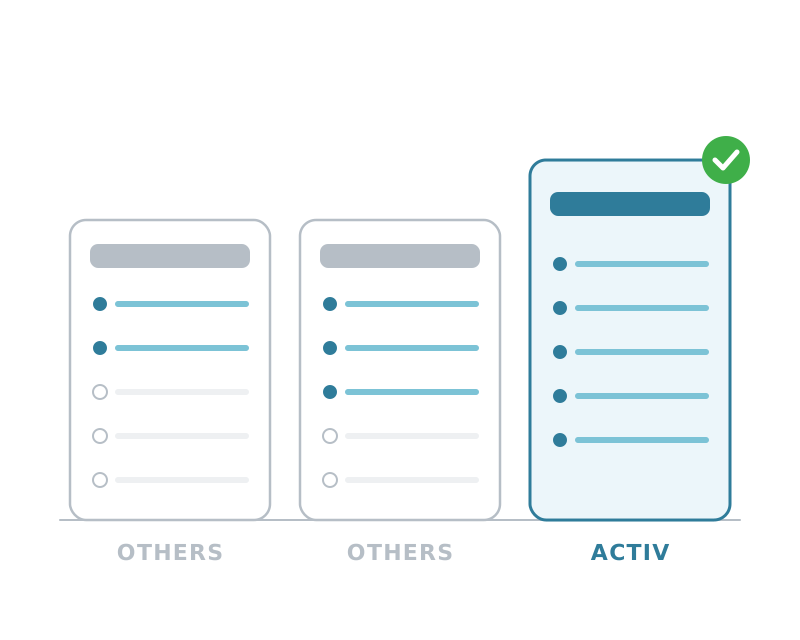
What to compare, before you compare prices.
These are the criteria that separate a service that merely answers from one that protects your residents, your assets, and your on-call team.
Multifamily fit
Is the service built for apartment operations, or a generic script adapted to yours? Fit determines whether triage and routing actually reflect how your community runs.
Intake choice
Can you choose IVR or conversational AI, and switch later, or are you locked into whichever single model the vendor happens to sell?
Dispatch speed
How fast does a true emergency reach the on-call technician, and what happens on no-answer? Silent failure at 2 a.m. is a flooded unit by morning.
Technician privacy
Does the tech’s personal number end up on a flyer, or does the service route through a real on-call rotation with masked callback?
Language coverage
Are calls handled and transcribed in English and Spanish, so on-call staff can assess urgency regardless of the language a resident speaks?
Record & reporting
Does every call flow into your PMS and into reporting your regional and corporate teams can see, or does it die on a message slip?
Four kinds of answering service, one set of criteria.
A fair read of the tradeoffs between a generic call center, a legacy answering provider, an AI-first startup, and a multifamily-specific platform. Every provider is different, so verify the specifics with anyone you evaluate.
| Generic call center | Legacy answering service | AI-first startup | Activ Answer | |
|---|---|---|---|---|
| Multifamily-only focus | No: one script for every industry | Partial: broad property-service focus | Rarely: general small-business focus | Built only for multifamily since 1994 |
| IVR (menu) intake | No: live agents only | Yes: its core model | No: AI only | Yes: Answer Automate |
| Conversational AI intake | No | No | Yes: its core model | Yes: Answer Intelligence |
| Choose IVR or AI, and switch later | No | No: IVR only | No: AI only | Yes: pick either on the same platform |
| Emergency dispatch speed | Variable: depends on agent availability | Fast for menu-routed calls | Varies by product | Under-30-second dispatch |
| Mobile app for on-call techs | No: relayed phone messages | Rarely | Sometimes | Push, voice & SMS with escalation |
| Masked callback (tech privacy) | No: exposes personal numbers | Rarely | Rarely | Yes: numbers stay private |
| EN/ES transcription & translation | Depends on the agent who answers | Rarely | Varies | Yes: transcribed and translated |
| PMS integrations | No: message slips | Limited | Emerging | Yardi, RealPage, Entrata & ResMan |
| Portfolio & corporate reporting | Basic call logs | Basic | Varies | Calls, transcripts, response times, trends |
Weighing intake styles specifically? Our IVR vs conversational AI guide goes deeper on resident experience, emergency routing, and cost.
What most answering services don't make obvious.
The gaps that matter rarely appear on a pricing page. These are the questions to ask any provider before you sign.
Whose phone actually rings?
A personal cell number on a flyer means calls on days off and no privacy, and when that person leaves, your “system” leaves with them. Ask whether dispatch runs on a real on-call rotation.
What happens on no-answer?
One channel is a single point of failure. Ask what happens when the first technician doesn’t pick up. Is there escalation to the next person, or does the call stop at the first technician?
Where does the record go?
A message on a sticky note never reaches your PMS. Ask whether every call is logged, with the resident’s message recorded and transcribed and pushed into Yardi, RealPage, Entrata, or ResMan, or reconstructed by hand each morning.
Who decides it's an emergency?
Without a multifamily definition, everything becomes a 2 a.m. dispatch or nothing does. Ask how the service decides, and see what counts as an emergency. Then ask for the result: how many calls on the emergency line end without calling a technician. On ours, across a sample of 3,000 apartment communities in August 2026, it was one in three: 27% ended after the caller heard the community’s emergency criteria, and 6% left a message for the office instead.
Where each kind of service fits.
Every category has a reason it exists. The question is which tradeoffs an apartment community can actually live with after hours.
Generic call centers
Live humans who can handle any industry, which is the limitation. They don’t know your properties, rotation, or emergency rules, so triage is slow and the record is a relayed message.
Legacy answering providers
Proven IVR menus, often bundled with broad property services. Reliable for routing, but usually IVR-only, light on mobile dispatch and masked callback, and slower to connect to modern PMS workflows.
AI-first startups
Conversational AI that captures context well, but frequently general-purpose rather than multifamily, AI-only with no IVR fallback, and still maturing on dispatch, reporting, and integrations.
Multifamily-specific platforms
Built around apartment operations end to end: IVR or AI by choice, under-30-second dispatch, mobile app, masked callback, bilingual transcripts, PMS integrations, and portfolio reporting. This is where Activ sits.
Comparing answering services, answered.
How should I compare apartment answering services?
Score every option against the same criteria: multifamily focus, whether you can choose IVR or AI, how fast a true emergency reaches the on-call technician, mobile dispatch, masked callback, EN/ES transcripts, PMS integrations, and portfolio reporting. The cheapest line item isn’t always the lowest total cost once you factor in missed escalations and manual morning data entry.
Is a live-agent call center better than an automated service?
Not for multifamily emergencies. A generic live agent reads a script but doesn’t know your on-call rotation, unit numbering, or what your community treats as an emergency. A multifamily-specific service triages accurately, routes to the right technician in seconds, and leaves a record in your PMS, coverage a general call center can’t match.
Do I have to choose between IVR and AI?
With most providers, yes. They offer one model. Activ is one of the few that lets you run proven IVR (Answer Automate) or conversational AI (Answer Intelligence) on the same platform, and switch later, without changing the dispatch, scheduling, reporting, or PMS workflows underneath.
What makes a multifamily-specific platform different?
It’s built around apartment operations: an on-call rotation instead of a personal cell, triage tuned to what a community treats as an emergency, masked callback to protect technicians, bilingual transcripts, and integrations with the property-management systems your teams already use.
Will it work with my PMS?
Activ connects with Yardi, RealPage, Entrata, and ResMan so after-hours calls, dispatch records, and reporting flow into the system your teams already use instead of living on message slips. See the Answer Automate and Answer Intelligence pages for how intake feeds those workflows.