
Two ways to answer. One right fit for your community.
IVR and conversational AI both answer your community’s calls and get true emergencies in front of an on-call technician. They just do it differently. This guide explains what each solution is, how each serves multifamily, and how to decide, without the hype.
The good news: this is not a decision you have to get perfect, and it is not one you get locked into. Activ runs both Answer Automate (IVR) and Answer Intelligence (conversational AI) on the same operational platform, so you can choose on fit and change your mind later. Below is how the two compare and a straightforward way to pick.
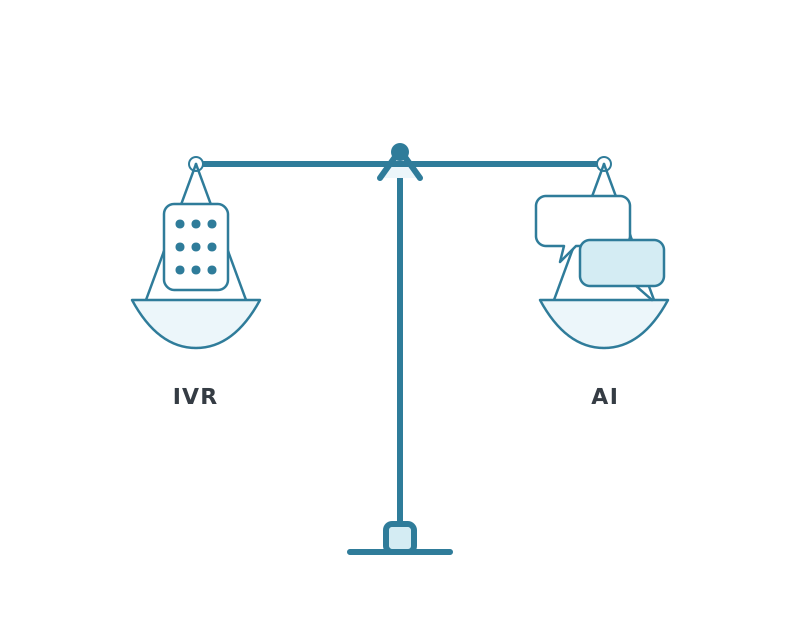
What IVR answering is.
IVR, or interactive voice response, is the menu-driven experience every caller already knows: “Press 1 for a maintenance emergency.”
A resident calls after hours, hears crisp, professional prompts, and presses a key. Emergency selections drop straight into the dispatch flow, where on-call rotation, triple notification, masked callback, transcripts, and reporting all fire the same way every time.
The appeal is predictability. Menus behave identically on call number one and call number one million, callers never wonder what to do, and the cost of service is lower. It is battle-tested across thousands of communities and millions of after-hours calls. At Activ, this is Answer Automate.
-
Predictable: the same routing, every single call.
-
Familiar: every caller already knows how to use a menu.
-
Affordable: the lower cost of service of the two options.
What conversational AI is.
Instead of a menu, callers describe the problem in their own words. The agent listens, asks natural follow-up questions, and understands what the resident actually needs.
The difference that matters most operationally: the agent can determine whether a caller’s issue actually qualifies as an emergency for your community. A running toilet at 11 p.m. gets logged for the morning; an active water leak dispatches immediately. That judgment is what cuts down non-emergency dispatches and the late-night calls your on-call staff dread.
It also answers simple questions in real time, such as office hours, pet policy, or where to find the trash valet schedule, so staff aren’t calling residents and prospects back the next day to answer things a person could have handled on the spot. At Activ, this is Answer Intelligence.
-
Conversational: callers describe the issue in their own words.
-
Qualifies emergencies: dispatches true emergencies, defers the rest.
-
Answers in real time: fewer next-day callbacks for staff.
How each serves an apartment community.
After-hours calls at a community are their own category: leaks and lockouts mixed with noise complaints and leasing questions. Here is where each solution earns its keep.
Real emergencies, dispatched fast
Both put genuine emergencies, whether burst pipes, HVAC failures, or gas smells, in front of the on-call technician quickly. IVR routes by keypress; AI routes by understanding what was said.
Protecting on-call staff
Fewer 2 a.m. non-emergency dispatches means less technician burnout. AI’s ability to qualify an issue is the biggest lever here; IVR relies on clear menu choices to keep routing honest.
Lockouts & courtesy patrol
Common after-hours requests that aren’t maintenance emergencies. AI can triage and direct them; IVR gives them a dedicated, predictable path.
Leasing & prospect questions
A prospect calling after hours is a lead. AI can answer availability and hours on the spot; IVR captures the message and routes it so no lead goes cold.
Resident & prospect experience
IVR is fast and familiar. AI feels like talking to someone who listens, and answers simple questions without a callback.
The same operations underneath
Whichever you choose, the on-call scheduling, triple notification, masked callback, transcripts, reporting, and PMS integrations are identical.
IVR and conversational AI at a glance.
An honest comparison. Neither is “better.” They trade off predictability and cost against conversation and context.
| IVR · Answer Automate | Conversational AI · Answer Intelligence | |
|---|---|---|
| Caller experience | Press-a-key menu, familiar to everyone | Natural conversation in the caller’s own words |
| Emergency routing | Fast: by menu selection | Fast: by understanding the described issue |
| Qualifies what’s an emergency | Relies on the caller’s menu choice | Agent judges against your community’s rules |
| Answers general questions live | No: captures a message | Yes: hours, policies, and more, in real time |
| Reduces non-emergency dispatch | Depends on menu design | Strong: the agent defers non-emergencies |
| Predictability | Highest: identical behavior every call | High, with natural conversational variation |
| Cost of service | Lower | Higher: though often only marginally |
It depends on the community.
There is no universal answer. The right choice depends on what your property is trying to solve and the character of the community. A simple way to think about it:
If cutting down non-emergency dispatch is the goal, conversational AI is the clear choice. Because the agent decides whether a caller’s issue actually qualifies as an emergency for your community, fewer technicians get pulled out of bed for things that could have waited until morning. That alone changes how on-call staff feel about the rotation.
If cost is the deciding factor, IVR is the safe, sensible pick. It’s battle-tested, predictable, and affordable. But get a quote for both before you decide. Conversational AI is more expensive, but the difference is often only marginal, and the reduced non-emergency dispatch plus the staff time freed up by answering simple questions in real time may more than make up for it. The cheaper line item isn’t always the lower total cost.
The character of your community matters too. Some resident populations prefer a quick, no-nonsense menu; others respond far better to a conversation. You know your residents.
Whichever you land on, Activ lets you pick the option that works best for your needs, and switching later is a configuration change. The dispatch, mobile app, reporting, and PMS integrations are the same underneath both.
Common questions.
- Is conversational AI reliable enough for emergencies?
- Yes. True emergencies dispatch to the on-call technician with the same speed and the same triple notification as IVR. The AI adds judgment about what qualifies; it doesn’t change how a real emergency is handled.
- Is AI really that much more expensive than IVR?
- It costs more, but often only marginally. Because it reduces non-emergency dispatches and answers routine questions without a staff callback, the total cost of ownership can come out even, or lower. Always compare quotes for both.
- Can we start with one and switch later?
- Yes. Both run on the same Activ platform, so moving from IVR to AI (or the reverse) is a configuration change, not a migration. Teams commonly run one across a portfolio and pilot the other at a single community.
- Do residents have to know which one we use?
- No. Either way they call the same number and reach an answer that’s built for multifamily. The rest, including dispatch, callback, and reporting, is invisible to them and identical to your team.