
Maintenance on-call schedule template
An on-call schedule template for apartment maintenance teams: a weekly rotation with a named backup, plus the rules that keep it true after the first swap. Copy the ten sections below, or download the schedule as a Word or PDF file and fill in your team’s names.
Most on-call schedules are right the day they are published. Then two technicians trade a weekend, someone takes a week off, and the list the answering service is calling no longer matches the people who are actually working. This template is a schedule and the rules that keep it current: who is on the rotation, how handoffs work, how holidays are shared, and what makes a swap official.
Free to adapt for your community. No email address required. Version 2026-09-25. See all templates.
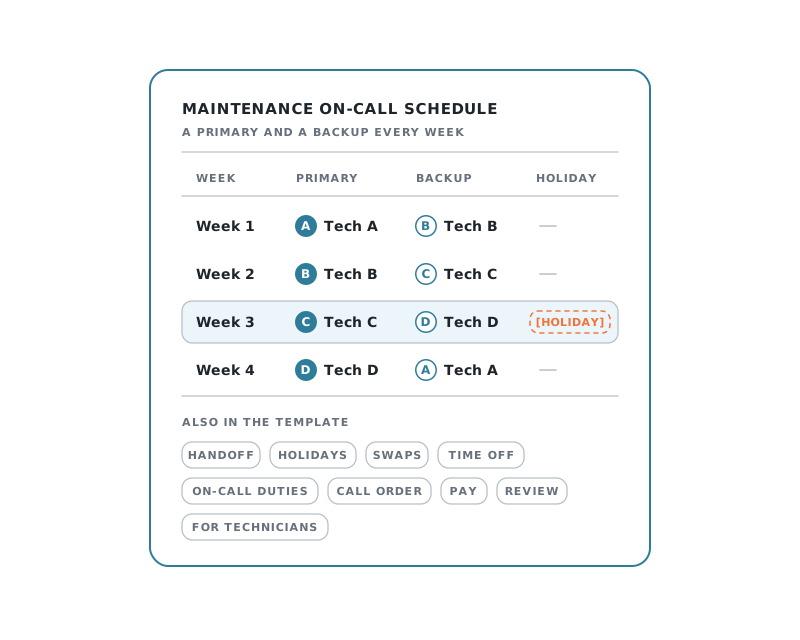
Ten sections, from who is on call to how they are paid.
Anything in [SQUARE BRACKETS] is a decision your team makes. The rest is wording to start from. How on-call and call-out time must be paid depends on where you operate, so have your HR or employment counsel review sections 7 and 9.
-
1
Who is on the rotation
The rotation covers [COMMUNITY OR PROPERTY GROUP]. Every maintenance technician joins it after [NUMBER] weeks of employment, and [THE SUPERVISOR TAKES SHIFTS / THE SUPERVISOR IS BACKUP ONLY]. Below [MINIMUM NUMBER] people, [ROLE] arranges cover from [ANOTHER PROPERTY / A VENDOR] rather than giving anyone back-to-back weeks.
-
2
Shift length and handoff
A shift runs one week, from [DAY AND TIME] to the same time the following week. At handoff, the outgoing technician passes on any open emergency, unit awaiting a return visit, or vendor already called, and hands over [KEYS, VEHICLE, PARTS]. The incoming technician confirms it to [ROLE] by [TEXT / EMAIL].
-
3
The schedule
Each week names a primary and, as backup, the person whose week comes next. After any holiday, swap or sick-day change, the shift must still have a primary and a backup who are two different people. The schedule is published [NUMBER] months ahead in [WHERE THE TEAM SEES IT], repeating the pattern below.
Week starting Primary Backup Holidays that week [DATE] [TECHNICIAN A] [TECHNICIAN B] [NONE] [DATE] [TECHNICIAN B] [TECHNICIAN C] [NONE] [DATE] [TECHNICIAN C] [TECHNICIAN D] [HOLIDAY], see section 4 [DATE] [TECHNICIAN D] [TECHNICIAN A] [NONE] -
4
Holidays
The covered holidays are [HOLIDAY LIST]. Each is assigned separately, by [A ROTATING ORDER / A DRAW / SENIORITY], and nobody works the same holiday two years running unless they ask to. The holiday technician replaces that week's primary from [START] to [END]. Assignments go into the schedule by [DATE] each year.
-
5
Swaps
Two technicians may swap shifts if both agree. The swap is recorded in [SCHEDULING SYSTEM OR SHARED CALENDAR] before the first swapped shift starts, and [ROLE] confirms it. Once recorded, the person who took the shift owns it, call-outs included. A swap inside [HOURS] of handoff also needs [ROLE]'s approval. An unrecorded swap does not count: calls go to whoever the published schedule names.
-
6
Time off and sick days
Approved time off goes into this schedule the day it is approved, with the replacement named; until then, the scheduled person stays responsible. A technician who falls sick mid-shift tells [ROLE], who moves the rest of it to [THE BACKUP / THE NEXT PERSON] and records the change.
-
7
What being on call means
The primary keeps [THE ON-CALL PHONE / THE ON-CALL APP] charged and within reach, stays within [MINUTES OR MILES] of the property, and is fit to drive and work for the whole shift. The backup stays reachable all week and follows the same distance and fitness rules [ALL WEEK / FROM THE MOMENT THEY ARE CALLED]. Emergencies are defined in [THE AFTER-HOURS MAINTENANCE POLICY]. An emergency call is returned within [MINUTES] of the first notification, and if phone help is not enough, the technician is on site within [MINUTES OR HOURS].
-
8
Who is called when nobody answers
The call order is the primary, then the backup, then [MAINTENANCE SUPERVISOR], then [PROPERTY MANAGER]. If nobody on the list responds, [WHAT HAPPENS: A VENDOR IS CALLED / THE OFFICE IS EMAILED]. Whatever answers the phone after hours works from this schedule and order, and every change here, swaps included, reaches it first by [THE SCHEDULING SYSTEM / AN EMAIL TO THE ANSWERING SERVICE].
-
9
Pay
A week as primary pays [STIPEND], and a week as backup pays [STIPEND / NOTHING]. A call-out pays [RATE] with a minimum of [HOURS], counted from when the call is returned. Time spent settling a problem by phone is recorded and paid as [RATE / PART OF THE CALL-OUT]. A holiday shift pays [RATE OR BONUS].
-
10
Review
[ROLE] reviews the rotation [QUARTERLY / TWICE A YEAR]: call-outs per technician, calls that did not need one, late or missed responses, and whether swaps have overloaded anyone.
The short version to hand each technician.
The full schedule is for whoever runs it. A technician needs the handful of rules that apply to their own week, in about a hundred words.
Your week runs from [DAY AND TIME] to the same time next week. Keep the phone charged, stay within [MINUTES OR MILES] of the property, and return an emergency call within [MINUTES]. Record any swap in [WHERE] before the shift starts, or the calls still come to you. If you are sick, tell [ROLE]. A primary week pays [STIPEND], and each call-out pays [RATE] with a [HOURS] minimum. Phone fixes pay [RATE / AS A CALL-OUT].
Four decisions the template leaves to you.
How many people share the rotation. Four technicians on weekly shifts means about thirteen weeks each a year; two means every other week. Section 1 is where you set the smallest rotation you will run, and what happens below it.
Whether the supervisor takes shifts. A supervisor on the rotation adds a person. A supervisor held back as a later step in the call order in section 8 keeps someone rested who can make the hard decisions at 3 a.m. Few small teams can have both.
How holidays are shared. A draw feels fair once. A rotating order that carries over from year to year stays fair, which is why section 4 asks you to record it.
The pay numbers. A stipend, a call-out rate and a minimum are the usual three. Set them with your HR or employment counsel, since the rules on paying for on-call time vary by location.
Our guide to building an apartment maintenance on-call rotation covers the rotation shapes, the fairness rules and the ways a rotation breaks down. The template above is the document that guide leads to.
Every schedule change has to reach whatever answers the phone.
A swap recorded in a spreadsheet still has to reach whatever answers the phone after hours. If that step is an email to an answering service, every trade and every sick day is a chance for a 2 a.m. call to reach someone who is off.
With Activ’s on-call scheduling, the rotation in this template is built once and repeats on its own, with holidays and one-off exceptions included. Each schedule names a primary and backups in the order you set. A primary who does not answer gets three calls, with a text on the third, before Activ moves to the next person on the list, and regional and corporate users can change who is on call at any community without going through a vendor. How an emergency reaches the technician is on our maintenance dispatch page.
Common questions about on-call schedules.
- How do you make an on-call schedule for maintenance?
- Decide who is on the rotation and how long a shift lasts, then give every week a primary and a backup, and publish it months ahead. Holidays, swaps, time off, response times, the call order and pay each need a written rule, because those are where schedules break. The template above covers all of them in ten sections.
- How long should an on-call shift be?
- This template uses a week, handed over on the same day and time each week. That keeps handoffs to one a week and gives technicians a predictable block to plan around. Splitting weekdays from weekends is an alternative, and it spreads the weekend load more evenly across a small rotation.
- How should on-call shift swaps work?
- Both technicians agree, the swap is recorded in the schedule before the shift starts, and a supervisor confirms it. After that, the person who took the shift owns it. The rule that matters most is that an unrecorded swap does not count, because whatever routes the after-hours calls only knows the published schedule.
- Should maintenance technicians be paid for being on call?
- The template gives you three numbers to set: a stipend for the week, a call-out rate with a minimum number of hours, and a rate for problems settled by phone. Whether time spent waiting on call counts as time worked depends on how restricted it is and on the rules where you operate, so settle the numbers with your HR or employment counsel.