
Building an on-call rotation your team can live with.
The on-call rotation is one of the few operational decisions that shows up in both your resident experience and your turnover numbers. Built well, it’s invisible. Built badly, it’s the reason your best maintenance technician takes a call from a recruiter.
Most rotations aren’t designed. They accumulate. Someone builds a list, people swap weeks, a tech leaves, a new one joins, and a year later the schedule is a set of informal understandings that only two people fully understand. This guide covers the shapes a rotation can take, the rules that make one survivable, and the five ways rotations break down. If you already know the shape you want, our on-call schedule template is the finished document, in Word and PDF.
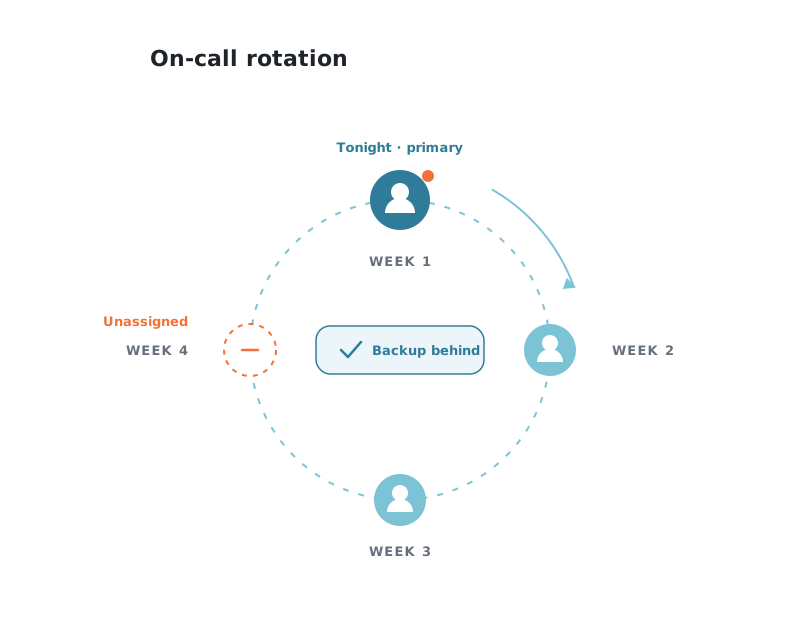
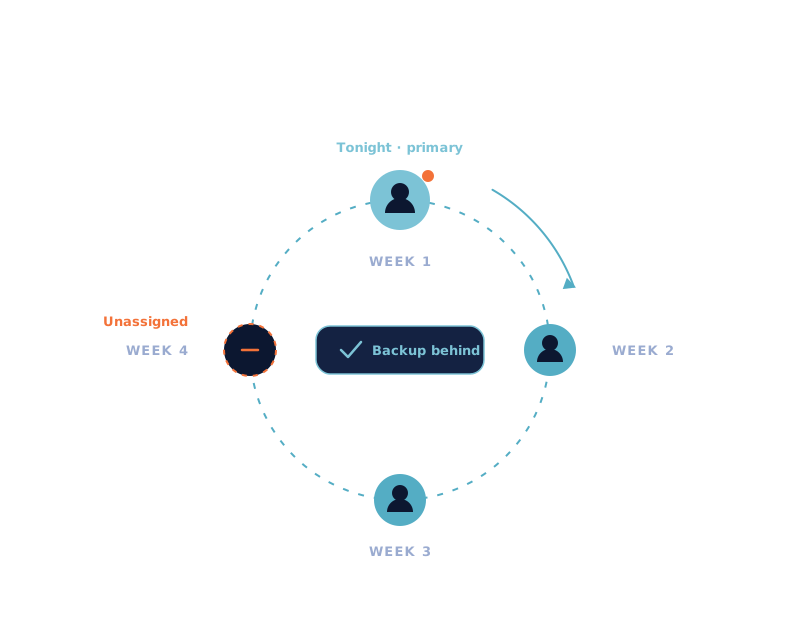
How do I keep on-call duty from burning out my maintenance team?
Rotate on a schedule people can plan around, name a backup for every shift, and keep one person from carrying consecutive weeks. Then cut the calls that should never have reached them, because being woken for a problem that could have waited until morning adds to the resentment.
A bad rotation is a retention problem before it’s a scheduling problem.
Maintenance is already the hardest on-site role to keep staffed. The rotation is one of the few levers you fully control.
The National Apartment Association put annual turnover for on-site maintenance technicians at 39.2%, the highest of any multifamily position, against an industry average of 32.7% across all on-site roles. Those figures are a few years old now, but nobody in the field will tell you the pressure has eased since.
The arithmetic of a short-staffed rotation is what makes it punishing. A four-person team splitting the year evenly puts each technician on call about thirteen weeks. Lose two of those four and the remaining pair are on call every other week. That is 26 weeks a year. Nobody signs up for that, and the people living it start answering recruiters. Understaffing and burnout aren’t two problems; they’re one loop.
What compounds it is that not every one of those nights needed to happen. A technician woken at 2:00 AM for a running toilet loses the same sleep as one woken for an active leak, but only one of those was worth it. The unnecessary calls are the ones that make a rotation feel unfair, and they’re the most fixable part of the whole system.
Four rotations that actually work.
Most communities land on one of these. The right choice depends on team size, portfolio density, and how far apart your properties sit.
Straight weekly rotation
Each technician takes a full week, then hands off. Simple to publish months ahead and easy for everyone to plan around. Its weakness is that a bad week is a whole bad week.
Split weekday and weekend
Weeknights and weekends are assigned separately, so the heaviest stretch isn’t always carried by the same person. More fair, more moving parts to track.
Primary with named backup
Every shift has a designated second who is expected to be reachable. This is the single biggest upgrade most rotations can make. It turns a missed call into a delay instead of a failure.
Pooled across a property group
Nearby communities share one rotation, spreading the load across a larger bench. Works well when properties are close together and technicians are cross-trained; poorly when they aren’t.
What separates a rotation people tolerate from one they resent.
The shape matters less than the rules around it. These five do most of the work.
Write down what an emergency is. A rotation without a written emergency definition invites calls about anything. When the criteria live only in people’s heads, the caller’s judgment becomes the standard, and the caller is a resident at midnight with a problem that feels urgent to them. Settle the emergency definition first; everything else follows from it.
Name a backup, and mean it. A primary who doesn’t answer should roll to a specific named person automatically. Rotations fail at the moment of the missed call, and a backup is the only thing that catches it.
Keep personal numbers out of it. Once a resident has a technician’s cell number, they keep using it on nights that tech isn’t on call, and long after that tech has left. Callbacks placed from the property’s number protect the technician and keep the rotation authoritative.
Make callback the default, not a truck roll. Most after-hours calls can be resolved, deferred, or triaged over the phone. A rotation feels far lighter when being on call usually means answering a question rather than driving in.
Leave a written record. When the resident’s own words, the unit, and the time are captured automatically, nobody re-litigates the night in the morning. That record is what lets a manager see whether the rotation is actually working, and whether one technician is absorbing more than their share.
-
A written emergency definition: so the caller isn’t the judge.
-
An automatic backup: a missed call becomes a delay, not a failure.
-
No personal cell numbers: callbacks from the property’s line.
-
Callback before truck roll: most nights end on the phone.
-
A record of every call: nobody re-argues the night in the morning.
Five ways a good rotation stops being one.
None of these announce themselves. They surface at 2:00 AM, on the night you can least afford it.
The list drifts
Someone swaps a weekend as a favor and nobody updates the master list. The rotation on paper and the rotation in practice drift apart until a 2:00 AM call proves it.
Holidays go unassigned
Thanksgiving and New Year’s are the shifts nobody volunteers for, so they get settled late, informally, or not at all, on the nights with the highest odds of a real emergency.
PTO isn’t reflected
A tech’s vacation is approved in one system and the on-call rotation lives in another. The call still routes to the person on a beach.
New hires are added late
A new technician spends months off the rotation while the veterans absorb their share, which is exactly how the veterans start looking elsewhere.
One person absorbs everything
The most reliable tech becomes the default backup for every missed call. It works right up until the day they leave, and then it fails all at once.
What these share is that the schedule stopped matching reality and no system noticed. Every one of them is a maintenance problem in the literal sense: the rotation needs upkeep, and manual upkeep is where it decays.
Your rotation is only as real as the phone system behind it.
A rotation on a spreadsheet is a plan. What actually routes the 2:00 AM call is the policy.
If your after-hours coverage depends on emailing an updated list to a third party, then your rotation is only as current as your last email, and every swap, every PTO day, and every new hire is a chance for a call to reach someone who isn’t working. That’s the drift described above, and it’s structural rather than careless.
With Activ, the rotation is built once and runs itself. Permanent or rotating coverage, holidays and property groups included. When an emergency comes in, the on-call technician is notified by email, push, and voice call at the same time; if they don’t answer, the system tries again and then rolls to the next person in the order you set, automatically. Callbacks are placed from the property’s number, so the technician’s personal line stays private. And because intake qualifies the call against your community’s own emergency criteria before anyone’s phone rings, the calls that do wake someone up are the ones that should have.
Corporate and regional teams can change who’s on call at any time without going through a vendor, which means the rotation stays accurate on the nights it matters.
Go deeper on the mechanics: on-call scheduling and maintenance dispatch.
Common questions.
- How many technicians do you need for a sustainable on-call rotation?
- It’s less about a headcount target than about the math of the rotation. Divide 52 weeks by the number of technicians actually in the rotation: four techs means roughly 13 weeks each, three means about 17, and two means every other week, or 26 weeks a year. When a team is short-staffed, the burden per person climbs fast, which is why understaffing and burnout compound each other.
- What makes an on-call rotation fair?
- Predictability more than volume. Technicians can plan around a rotation they know months ahead; what wears them down is uncertainty, unassigned holidays, and being called for things that weren’t emergencies. A written emergency definition, an even holiday distribution, and a real backup who shares the load do more for morale than shortening anyone’s week.
- Should on-call technicians use their personal cell numbers?
- It’s common and it causes problems. Once a resident has a technician’s personal number, they use it on nights that technician isn’t on call, and after that technician leaves the company. Routing through the system and placing callbacks from the property’s number keeps the rotation authoritative and the technician’s privacy intact.
- How do you reduce unnecessary after-hours dispatches?
- Define what an emergency is, in writing, and make sure whatever answers the phone enforces that definition. Most unnecessary 2:00 AM dispatches happen because a caller self-assessed the urgency, or because a message-taker had no criteria to apply. Qualifying the call against your community’s own rules before anyone is woken up removes most of them.