
Live answering or automated? Know what you’re paying for.
Many apartment communities hand after-hours calls to a third-party live answering service. A person picks up, takes a message, and phones your technician. It sounds reassuring. But the model carries costs and delays that don’t show up until you’re living with them. Here’s an honest look at live versus automated intake.
This isn’t about whether humans are good at their jobs. Live agents work hard. It’s about whether a general-purpose call center, paid by the minute and relaying messages by hand, is the right way to handle a burst pipe at 2:00 AM in a specific unit of your community. Compare the two models on the things that actually affect residents, technicians, and your budget.
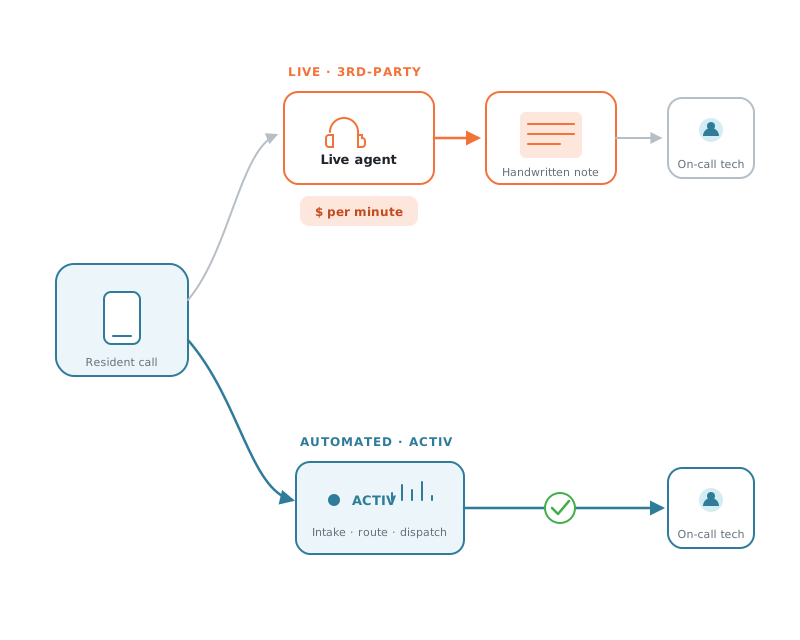
What a third-party live answering service actually does.
A general call center answers on your behalf, takes down what the resident says, and relays it to your team.
A resident calls after hours and reaches an agent, often someone answering for dozens of unrelated businesses that night. The agent listens, types or writes a message, decides whether it sounds urgent, and then telephones your on-call technician to pass it along. If they can’t reach the tech, the message may sit until someone follows up.
The appeal is real: a person picks up, and a nervous resident hears a human voice. The trouble is everything that happens after that: the metering, the hand-off, and the manual upkeep. That is where the model works against you.
-
A person answers: the genuine strength of the model.
-
A message is taken: by hand, in the agent’s words.
-
Your tech is phoned: a second call to relay the first.
You’re billed for the conversation.
Live answering is usually priced by the minute, which means your bill rises exactly when your community is busiest.
A small bucket of minutes
Plans typically include a limited pool of minutes. It looks affordable on paper, until a busy month arrives.
Overage on everything else
Go past the included minutes and every additional minute is billed. A high-call night or a long call costs you directly.
Cost that scales the wrong way
You pay more precisely when volume spikes, whether a storm, an outage, or a holiday, the moments you can least afford surprises.
There’s a subtler problem, too: when a service is paid by the minute, longer calls aren’t a problem for the vendor. They’re revenue. Your incentives and theirs don’t line up. For a full breakdown of the pricing models and the fees below the headline rate, see what an answering service actually costs.
Every retelling loses something.
A live agent is a middle layer between the resident and your technician, and middle layers add delay and drift.
When an agent hand-writes a resident’s report and then phones it to your technician, the details pass through a person who doesn’t know your property, your units, or your history. “Water in the bathroom” might be a slow drip or an active flood, and by the time it’s relayed, the nuance that told you which is often gone. There’s usually no recording and no transcript to check against.
Automated intake removes the middle layer. The resident’s own words are captured, the emergency is routed directly, and the technician receives the resident, unit, and details, with the recording and transcript attached, instead of a second-hand summary. Nothing is lost in the retelling because there is no retelling.
Who’s on call tonight, and who’s keeping that current?
With many live services, the on-call schedule is something you maintain by hand and hope they got right.
Send the updated rotation over. Email a change when someone swaps a shift. Hope the agent references the right list at 2:00 AM. Every manual step is a chance for a call to reach someone who isn’t working, and after-hours is exactly when that failure hurts most.
With Activ, the schedule is built once and runs itself: permanent or rotating coverage, automatic backup escalation when someone doesn’t answer, and changes your own team makes directly, with no third party to email.
See how the rotation works: On-call scheduling You can also read the guide to building a rotation your team can live with.
Live third-party vs. automated intake.
A fair comparison of the two models on what matters for after-hours apartment calls.
| Live · 3rd-party service | Automated · Activ | |
|---|---|---|
| Pricing model | Per minute, with overage past included minutes | Not metered by talk time |
| Path to the technician | Agent takes a message, then phones the tech | Technician notified directly, in under 30 seconds |
| Recording & transcript | Usually none: a hand-written summary | Original recording and transcript retained |
| On-call schedule | Often maintained and sent manually | Set once; automatic backup escalation |
| PMS integration | Rare: a general call center | Resident sync; work order creation with Entrata and ResMan |
| Consistency | Varies by agent and how busy the night is | Identical handling on every call |
| Bilingual handling | Depends on which agent answers | Spanish intake with EN/ES transcripts |
Common questions.
- Is a live answering service better because a human picks up?
- A human voice is the real appeal, but for after-hours apartment calls, what matters most is speed and accuracy of dispatch. A live agent still has to take a message and phone your technician, which adds delay and a chance for detail to get lost. Automated intake routes and dispatches directly, and keeps the original recording and transcript.
- What are the hidden costs of a live answering service?
- Most live services price per minute with a small bucket of included minutes, then bill overage for everything beyond it. Cost rises with call volume and how long each call runs, so a busy night or a chatty agent directly increases your bill. Automated answering doesn’t meter the conversation the same way.
- How is dispatch different between live and automated?
- With a live service, the agent writes down what the resident said and then calls your on-call technician to relay it, a human hand-off with no recording behind it. Activ notifies the technician directly with the resident, unit, and details attached, plus the recording and transcript, typically in under 30 seconds.
- Do I still have to manage the on-call schedule myself?
- With many live services, yes. You send or update the on-call list manually, and any drift causes misroutes. With Activ, you build the rotation once, backups escalate automatically, and corporate can change who’s on call at any time without emailing a third party.