
Building AI answering you can trust.
A conversation with Shawn Lindstrom, Activ’s CTO, on why the company waited to ship conversational AI, how it decides what counts as a real emergency, and what it actually means to build after-hours answering that operators and residents can trust.

Why we waited to ship AI.
Q. You spent two decades on automated answering before putting conversational AI in front of a resident’s 2 a.m. emergency. What made you comfortable doing that?
Operators have embraced AI with a great deal of enthusiasm, combined with some healthy skepticism, and honestly, I think that’s the right posture. When I set out to plan our roadmap for conversational AI, I wouldn’t say I was nervous. We decided to put a solution into the marketplace only when we felt we could offer something genuinely better than what was available at the time, and we could only do that once the underlying technology reached a level of maturity we were comfortable building on.
With more than 20 years focused on automated answering, we knew we had to get it right. As a technologist, it’s easy to get caught up in the excitement and the possibilities AI has unlocked. But the human factors matter more. We’re often serving residents in a moment of stress and urgent need. Therefore, we must express our human empathy through the systems we build to serve them in those situations.
“We must express our human empathy through the systems we build.”
Two layers before anyone is dispatched.
Q. How does the AI decide what’s a real emergency versus what can wait until morning?
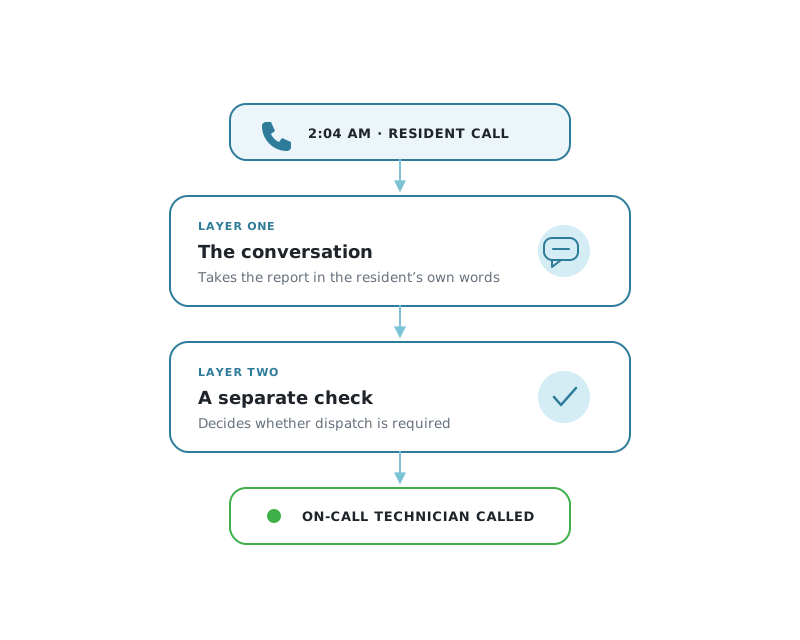
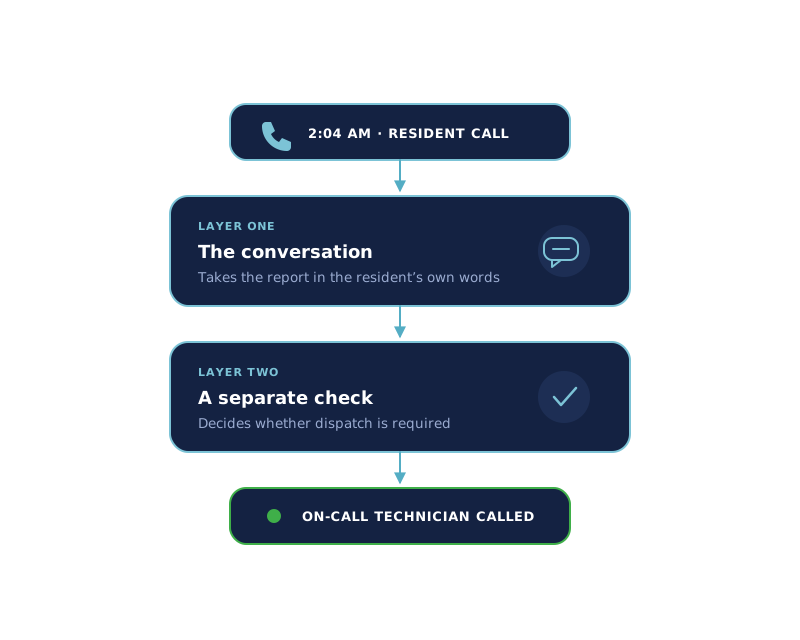
Each community tells us what constitutes a real emergency at their property, and our agent uses that criteria to guide its conversation with the resident. While the agent will perform an initial assessment, it doesn’t have the final say on dispatch. After the conversation concludes, a specialized classifier reviews the exchange as a whole and makes the final judgment on whether dispatch is required, keeping the community’s criteria in focus. So there are really two layers: the agent’s initial assessment, and a stronger classification review on top of it.
Q. When the system is uncertain, which way does it lean, and why is that safe?
The classifier is the final arbiter, and it leans toward dispatch whenever there’s any doubt. The reason that works so well is that dispatch isn’t an incontrovertible order to go on site. It’s an on-call technician returning the resident’s call to learn more about the issue at hand before deciding if they need to head out. So erring toward dispatch costs very little, and it ensures we never sit on a genuine emergency.
Q. Where does a human stay in the loop?
As I mentioned, we’re never blindly telling a technician to respond to a unit. Dispatch is a call that gives the tech everything they need before they return the resident’s call and the decision to go on site stays with the tech. The real advantage of conversational AI is that it screens non-emergencies far more effectively than a traditional IVR or a live agent. Communities can expect fewer call-outs to on-call staff without missing any true emergencies.
With IVR, even when you prompt the resident about what qualifies as an emergency at their community, they can still choose to leave a message which leads to a call-out regardless of how urgent the issue actually is. That’s the gap the AI closes. It’s also why we walk through IVR versus AI honestly rather than pretending one fits every community.
Built for the calls that don’t go to plan.
Q. What happens on the hard calls: a heavy accent, a panicked caller talking fast, long silences, or someone who just wants a human?
We built a very robust agent and conversation-handling system. Callers don’t have an escape hatch like pressing 0 or shouting “agent” to reach a person because that hatch simply isn’t there. Communities forward to us precisely when they can’t answer, so our agent has to be ready for anything. In the very worst case, the community is notified of the conversation, the AI does its best to make sense of it, and we provide access to the full, recorded conversation so nothing is ever lost.
Q. You officially support only English and Spanish, even though the model can handle more. Why draw that line on purpose?
Official support means we’ve tested a large number of scenarios internally and vetted both English and Spanish for clarity and accuracy. We could support more languages, and we will, but each one has to meet the same standard of vetting and care we put into Spanish. Our Spanish-speaking staff were a critical part of that testing, and we’re simply not comfortable rushing into languages we don’t speak ourselves.
It’s also worth pointing out that marketing “50 languages” in the U.S. is a bit of a gimmick. Spanish is by far the most important secondary language to support, and we’d rather do it exceptionally well than do a dozen languages poorly. You can read more about our bilingual answering approach.
Q. It’s 2 a.m. and a real emergency comes in. What makes you confident the dispatch actually lands?
All of the above. We take the mindset that we have to be as reliable as 911. That means standing up and maintaining a highly available application in the public cloud, including geographic redundancy. We demand that same high availability from the vendors that actually carry our calls, send our SMS, and deliver our email. We don’t have maintenance windows; the system is designed to always be available. We take availability, reliability, and security very seriously, and we work continuously to make the system as fault-tolerant as possible.
“We take the mindset that we have to be as reliable as 911. We don’t have maintenance windows.”
Why multifamily, and why private.
Q. What makes building AI answering for multifamily specifically different from a generic “AI receptionist”?
When you try to be everything to everyone, the best you can deliver is an average solution. When you specialize the way we do in multifamily, you’re never distracted, and you can go deep to meet your customers’ needs. When we build a feature, the focus is narrower. We don’t have to satisfy as many constituents, and we don’t have to make compromises.
And it isn’t only about the technology. Our business is designed around what owners and management companies actually need. We don’t require long-term contracts, so we earn the business every month, and we make it easy to add and remove communities as portfolios change. Our whole company thinks in terms of what multifamily needs. Can we serve other verticals? Absolutely, and we welcome that business. But multifamily will always come first.
“When you try to be everything to everyone, the best you can deliver is an average solution.”
Q. What did 20 years and something like half a billion calls teach you that a newcomer wouldn’t know?
The biggest lesson is that reliability is table stakes. It’s the price of entry, not a differentiator. Beyond that, we’ve watched entrants in the answering-service world come and go, which taught us how much consistency and truly great support matter over the long haul. We have a unique understanding of community managers: we anticipate their needs and design solutions that don’t require them to be hands-on. Once they’re set up with us, we like to melt into the background and just do our job. Most important, when they do need us, we answer their calls and emails 24/7. The average tenure of our support team is 14 years.
Q. What do you make of the wave of well-funded, AI-first answering startups?
Honestly, AI-first startups aren’t necessarily making mistakes. They’re often incredibly well funded and hire talented operators, and we respect that. The real difference is that it’s a numbers game for them. They need to grow fast and exit is the number one priority. For us, the number one priority is our customers. It’s a big part of why we prefer to stay private: we chart our own course and make decisions based on what benefits our customers, not investors.
Our unique advantage is our staying power and obsessive focus on the needs of multifamily. Our long operating history gives us room. Time to breathe. Time to think. Time to be deliberate about building things that actually matter for our customers.
Q. Where does this go next?
We’re excited to keep extending and enhancing how we use AI, and to adopt the best of what the market has to offer. In the near term, we’re focused on deepening our core support for maintenance and building more robust integrations with our property management software partners. Operators can expect the same consistency and reliability that has earned the trust of thousands of communities. AI is a tremendous enabler, but our focus will always be on meeting customers where they are using whatever technology makes the most sense to deliver the best outcome.
Want to see the AI Shawn describes? Explore Answer Intelligence, or read how it fits alongside proven IVR in our IVR vs conversational AI guide. Evaluating vendors yourself? Shawn’s answers here map directly onto the twelve questions to ask an AI answering vendor.