
Twelve questions to ask before you put AI on your resident line.
Every AI answering vendor demos well. A demo is a call that goes right, and the calls that determine whether you keep the vendor are the ones that go wrong at 2:00 AM. These are the questions that separate the two, along with what a good answer actually sounds like.
Ask every vendor the same twelve, including us. None of them are trick questions and none are proprietary. Any vendor who has genuinely thought about running an emergency line should be able to answer all of them without checking with someone. The ones who can’t are telling you something useful.
Every system misjudges a call eventually.
No vendor will tell you their AI is perfect. What separates them is whether they’ve thought carefully about the failure and built for it, or whether the question makes them uncomfortable.
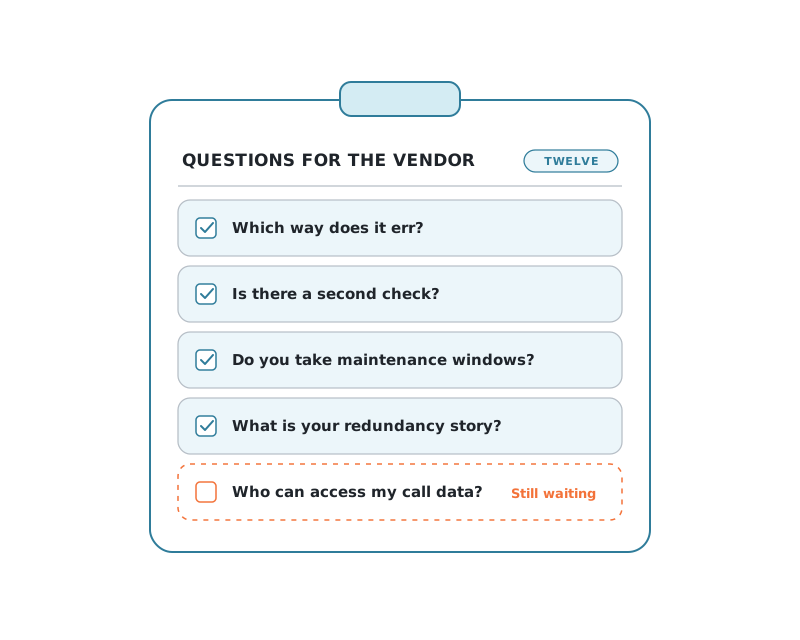
Q. When the AI misjudges an emergency, which way does it err?
- Why it matters
- The two failure directions are not equally costly. Waking a technician for a running toilet costs an hour of sleep. Failing to dispatch on an active leak costs a unit, and possibly a resident.
- What a good answer sounds like
- A clear, unhesitating answer that the system leans toward dispatching, with the reasoning behind it: ideally that an unnecessary dispatch usually starts as a phone callback rather than a truck roll, which makes erring toward action cheap.
Q. Is there a second check, or does one model decide alone?
- Why it matters
- A single model that both talks to the resident and decides whether to dispatch has no independent review of its own judgment. A separate classifier evaluating the same call is a meaningfully different architecture.
- What a good answer sounds like
- A specific description of how many layers make the call and what each one does. Vague answers about “advanced AI” are a signal there is only one layer.
Q. Can I define what counts as an emergency for my community?
- Why it matters
- A single-bath unit, a property in Phoenix in July, and a building with a history of lockouts do not share one emergency definition. Generic criteria produce dispatches that feel arbitrary to your team.
- What a good answer sounds like
- Yes, per community, and configurable after launch without a support ticket that takes a week. Ask to see how a rule is changed.
Ask what happens at 2:00 AM when something fails.
After-hours answering is infrastructure. Hold it to the standard of a dial tone. Ask reliability questions the way you’d ask them of a utility.
Q. Do you take maintenance windows?
- Why it matters
- A scheduled maintenance window is a period during which your residents cannot reach anyone. Overnight is precisely when vendors like to schedule them, and precisely when you need the line up.
- What a good answer sounds like
- No maintenance windows, with an explanation of how updates ship without downtime. If the answer is “we notify you in advance,” that’s an outage with a calendar invite.
Q. What’s your redundancy story?
- Why it matters
- Storms take out regions. The night a hurricane knocks out power across your market is the night your call volume peaks and your vendor’s local infrastructure is at risk.
- What a good answer sounds like
- Geographic redundancy, described concretely: what runs where, and what happens when one location is lost. A vendor that has thought about this can answer in specifics.
Q. What happens to a call in progress if the AI itself fails?
- Why it matters
- Graceful degradation is the whole question. A system that simply drops the call in a failure state is worse than the voicemail box you replaced.
- What a good answer sounds like
- A described fallback path that still results in the resident being heard and the emergency reaching someone, not a promise that failure won’t happen.
Your residents are the ones on the phone.
The buyer evaluates the dashboard. The resident experiences the call. These questions are about the second one.
Q. Which languages do you actually support, and what does “support” mean?
- Why it matters
- Nearly every AI vendor claims dozens of languages, because the underlying models technically produce them. Producing a language and supporting it operationally, with transcripts, translation, and a support team who can review the call, are different commitments.
- What a good answer sounds like
- A short, specific list, with an honest account of what happens in an unsupported language. A vendor claiming fifty languages has usually tested a handful.
Q. Was this built for multifamily, or configured for it?
- Why it matters
- A general-purpose AI receptionist adapted to apartments doesn’t know what a unit number is for, why the on-call rotation matters, or that a lockout at 1:00 AM is a different problem than a lockout at 1:00 PM.
- What a good answer sounds like
- Evidence in the product itself: on-call rotations, unit-level context, PMS integration, emergency criteria. A page of multifamily logos is not evidence.
Q. What happens when a resident just wants a human?
- Why it matters
- Every vendor answers this differently, and there are defensible answers in both directions. What matters is that the vendor has a position and can defend it, rather than an escape hatch that drops the resident into a voicemail box.
- What a good answer sounds like
- A clear, deliberate policy, and an explanation of where the caller actually ends up. Ask them to walk you through it end to end.
The record, the data, and the exit.
These are the questions people skip during a demo and regret during a dispute or a renewal.
Q. Do I get the recording and the transcript, or a summary?
- Why it matters
- A summary is someone else’s interpretation of what your resident said. When a resident disputes how a call was handled, an interpretation isn’t evidence.
- What a good answer sounds like
- Both the original recording and a transcript, attached to the call record, available to the technician that night and the manager the next morning.
Q. Who can access my call data, and how long is it retained?
- Why it matters
- Resident calls contain names, unit numbers, and sometimes details residents would consider private. Ask about retention and access before an incident, not after.
- What a good answer sounds like
- A specific retention period, a clear account of who at the vendor can access recordings, and the ability for you to control access within your own organization.
Q. What’s the contract term, and what does it cost to add or remove a community?
- Why it matters
- A long lock-in is how a vendor protects itself against you being disappointed. Portfolios also change constantly: acquisitions, dispositions, management wins and losses.
- What a good answer sounds like
- No long-term commitment, and adding or removing a community that doesn’t require renegotiating anything. Ask what happens the month you lose a management contract.
The answers matter less than the hesitation.
There are legitimate differences of opinion inside several of these questions. Reasonable vendors disagree about human fallback, about how aggressively to dispatch, about how many languages to commit to. A confident, specific answer you disagree with is far more reassuring than a smooth one that avoids the question.
What you’re really testing is whether the vendor has operated an emergency line long enough to have been wrong, and to have built something in response. Our CTO works through several of these directly in this interview: the two-layer dispatch decision, the deliberate absence of a caller escape hatch, why we officially support only English and Spanish, and what 911-grade reliability actually requires.
For the regulatory side of the same evaluation, covering recording consent, disclosure, and what actually applies to an inbound resident call, see recording, consent, and AI disclosure. For how the categories of provider differ, see the answering service comparison.