
Recording, consent, and AI disclosure: what actually applies to you.
There is a great deal of noise about AI calling regulation right now, and most of it is about a problem you don’t have. Here’s a plain reading of what governs an apartment community answering its own phone after hours, and which obligation is the one that actually bites.
The short version: nearly all of the recent AI-calling regulation targets outbound calls: robocalls, telemarketing, voice cloning. A resident who dials your community at midnight and reaches an automated system is a fundamentally different scenario. The rule most likely to affect you today is about recording consent, and it long predates AI answering.
The rules were written for robocalls, not for your front door.
Understanding who the regulators were aiming at makes the whole landscape easier to read.
The current wave of AI-calling regulation traces back to voice cloning used deceptively, most visibly a faked political robocall during the 2024 primaries. Regulators responded to that: unsolicited calls placed to people who never asked for them, using a synthetic voice to impersonate or mislead.
An after-hours maintenance line inverts every element of that. The resident places the call. They’re calling a number their own community gave them. Nothing is being sold, and nobody is being impersonated. When you read each rule with the outbound/inbound distinction in mind, most of the apparent exposure resolves, and the one real obligation stands out clearly.
Recording consent is the one to get right.
It has nothing to do with AI. It applies to a live answering service, a voicemail box, and an automated system equally, and it varies by state.
Federal law sets a one-party consent standard: a call may be recorded as long as one participant knows. Most states follow suit. But a dozen states require all parties to consent, and several attach criminal as well as civil penalties.
For a multifamily operator this is more manageable than it sounds, because the safe practice is uniform: announce the recording at the start of every call. Do that and you satisfy the strictest state without having to know which state your caller was standing in, which matters more than it used to, since a resident’s mobile number tells you nothing about their location.
If you operate across several markets, resist the urge to configure different behavior per property. One all-party-safe greeting everywhere is simpler to maintain, simpler to audit, and doesn’t fail when someone travels.
States requiring all-party consent
Twelve states, as commonly summarized in 2026.
- California
- Connecticut
- Delaware
- Florida
- Illinois
- Maryland
- Massachusetts
- Montana
- New Hampshire
- Oregon
- Pennsylvania
- Washington
Definitions and exceptions differ by state (some treat in-person and telephone conversations differently), and the list changes. Confirm current requirements for your markets with counsel.
What the FCC ruling says, and what it doesn’t.
It is widely described as “the FCC banned AI robocalls.” That is not quite what happened, and the difference matters.
On February 8, 2024, the FCC issued a declaratory ruling confirming that voices generated by AI count as “artificial” voices under the Telephone Consumer Protection Act. Nothing was newly banned. AI-generated voices were placed inside the TCPA’s existing framework for artificial and prerecorded voice calls, which are lawful but require prior express consent when placed to a consumer.
That consent requirement is the crux, and it is a rule about outbound calling. It governs calls you place to someone. It does not describe how you may answer a call someone places to you. A resident dialing the after-hours number their lease gave them has not been robocalled.
Separately, in an August 2024 rulemaking, the FCC proposed defining “AI-generated calls” and requiring a clear disclosure at the start of such calls. That proposal has been pending since; as of August 2026 it has not been finalized, so there is no general federal start-of-call AI disclosure rule in effect. It is a reasonable thing to expect eventually, and a reasonable thing to do voluntarily now, but it is not currently a requirement.
The state AI laws, read carefully.
Several are cited constantly in vendor marketing as though they govern inbound business calls. Mostly, they don’t.
California AB 2905
In effect since January 1, 2025. Requires an automated call carrying a prerecorded message to disclose that the message was AI-generated. It is an outbound robocall rule: it governs calls placed to people.
California SB 1001
The 2018 “bot disclosure” law, frequently miscited. Its text is limited to online communications (websites and web applications) and to bots that deceive in order to drive a sale or influence a vote. It does not reach telephone calls.
Texas TRAIGA (HB 149)
Effective January 1, 2026. Targets intentional misuse, meaning AI developed or deployed to manipulate, unlawfully discriminate, or infringe rights, along with government agency use. Answering a maintenance call is not within its concerns.
Colorado AI Act
Widely cited as imminent; it isn’t. Its compliance date has been pushed repeatedly, from February 2026 to June 2026 and then in May 2026 to January 1, 2027, while the legislature works on replacing it with a narrower framework. Track it, but do not plan around it yet.
The pattern is consistent: these laws address deception, outbound solicitation, and consequential automated decisions. An inbound call in which a resident reports a leak and the system decides whether to wake a technician sits outside all of them. That may not stay true forever, which is why disclosure is worth doing before anyone requires it.
What a defensible after-hours AI call sounds like.
Compliance and good resident experience point the same direction here, which makes this easy.
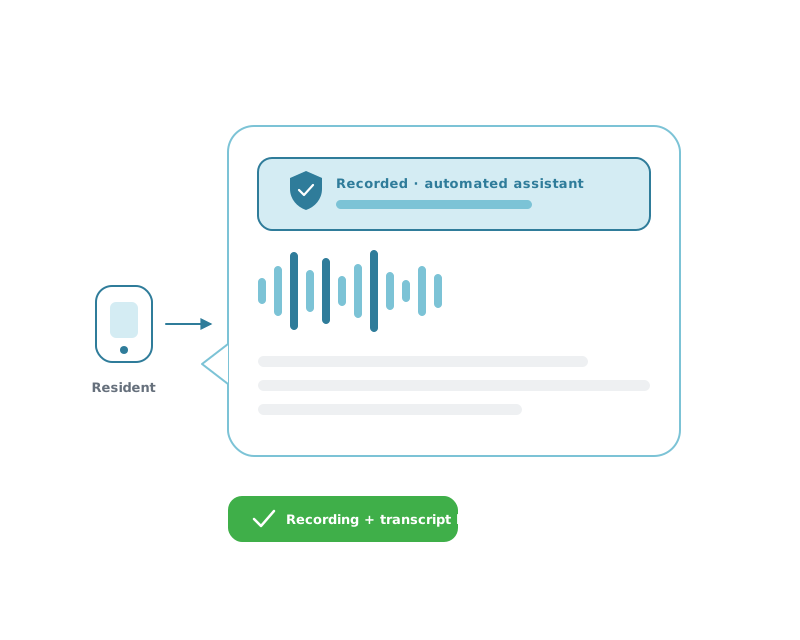
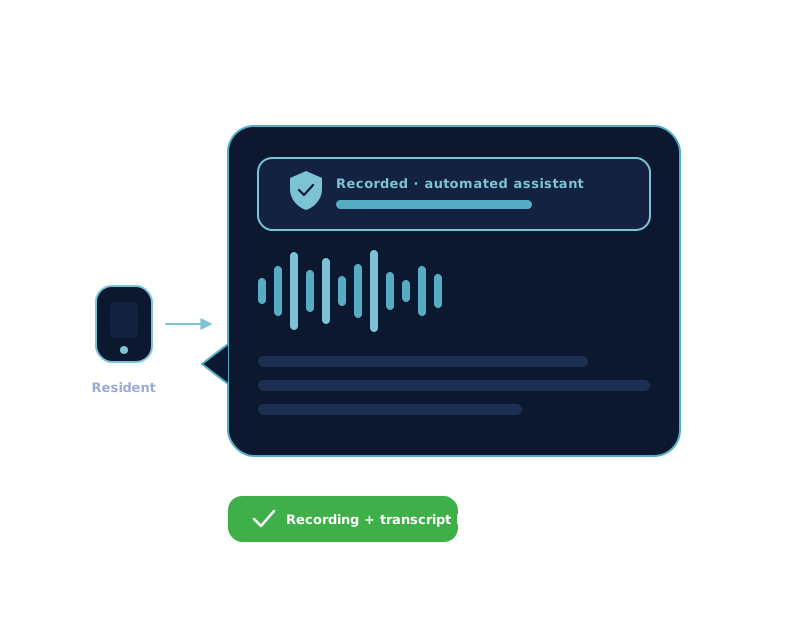
The greeting discloses both things at once. The resident learns the call is recorded and that they’re speaking with an automated assistant, in the first few seconds, in plain language. This clears the all-party consent bar everywhere and gets ahead of any future disclosure requirement in a single sentence.
Life-safety instruction comes early. Anyone in immediate danger should be told to hang up and dial 911 before anything else happens. This isn’t a regulatory obligation so much as an obvious one.
The record is kept and reachable. The recording and transcript are retained and attached to the call, so what the resident actually said is available to the technician that night and to the manager the next morning, and to you if anyone ever questions how a call was handled. A hand-written message from a call center leaves you with nothing to point at.
Language is handled honestly. If a resident is answered in Spanish, the recording, transcript, and translation should all exist so the on-call technician can act on what was said. See bilingual answering for how that works.
Activ scripts greetings with you during onboarding, including recording disclosure, and keeps the recording, transcript, and translation attached to every call. Our CTO covers the reasoning behind several of these choices in this interview.
Common questions.
This guide is general information for apartment operators, current as of August 2026. It isn’t legal advice. Requirements change and vary by state. Confirm your obligations with your own counsel.
- Do I need resident consent to record after-hours maintenance calls?
- Federal law follows a one-party consent standard, and many states match it. But a dozen states require every party to consent, so the practical answer for most operators is to announce the recording at the start of every call, which satisfies the strictest state and removes the question of where your caller was standing. If you operate in more than one state, a single all-party-safe greeting is far simpler than maintaining different behavior per market.
- Does the FCC’s AI ruling mean I can’t use AI to answer resident calls?
- No. The February 2024 declaratory ruling confirmed that AI-generated voices count as “artificial” voices under the TCPA, a framework built around outbound calls placed to consumers, where prior express consent is the issue. A resident who dials your community’s number and is answered by an AI is a different situation entirely: they initiated the call. The ruling is aimed squarely at robocalls, not at how you answer your own phone.
- Does an AI have to announce that it’s an AI?
- As of August 2026 there is no general federal requirement that an AI disclose itself on an inbound call. The FCC proposed a start-of-call AI disclosure in an August 2024 rulemaking, but that proposal has not been finalized. Several state laws impose disclosure in narrower circumstances. Our own view is that disclosure is simply the right practice regardless of what’s required. A resident with an emergency deserves to know what they’re talking to.
- Is my answering vendor responsible for compliance, or am I?
- Practically, both. But the obligations attach to the calls made on your behalf, so you can’t fully delegate the exposure. That makes your vendor’s defaults your defaults. Ask specifically how the greeting handles recording disclosure, whether it can be configured per state, how long recordings and transcripts are retained, and who can access them.
- How does Activ handle recording and disclosure?
- Conversational AI calls are recorded and transcribed so the technician and the manager have the resident’s own words rather than a second-hand summary, and greetings are scripted with you during onboarding, including recording disclosure. If you operate in an all-party consent state, or in several states at once, raise it during setup and we’ll configure the greeting accordingly.