
Should AI answer your leasing line?
AI on the leasing line is the loudest conversation in multifamily right now, and most of it is being had by people selling it. Here’s a more careful look: which calls AI genuinely improves, which ones it makes worse, and why those two categories aren’t the same.
We build AI answering, so read this knowing where we sit. But we’d rather be useful than enthusiastic: the case for AI answering a maintenance emergency is much stronger than the case for AI running your leasing conversation, and the industry has spent two years blurring the two. Model quality has little to do with it. What matters is whether the call has a right answer.
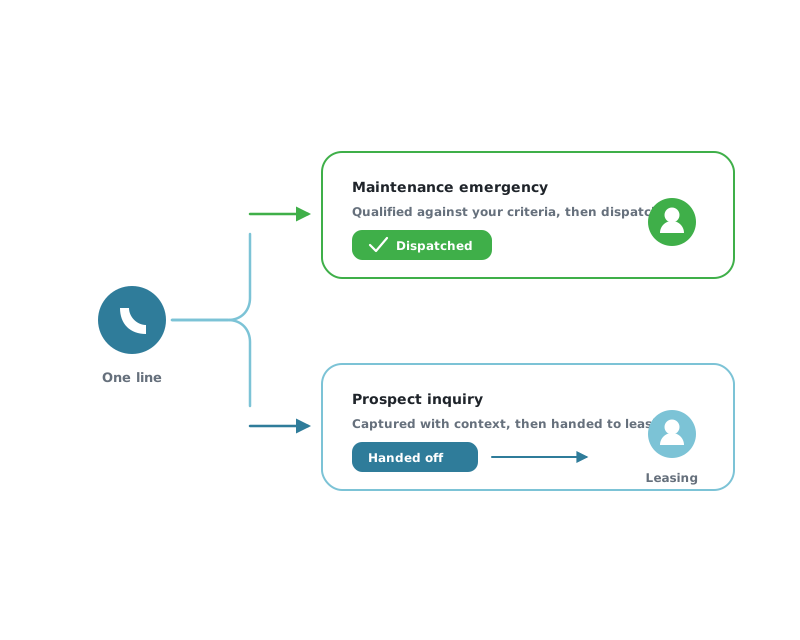
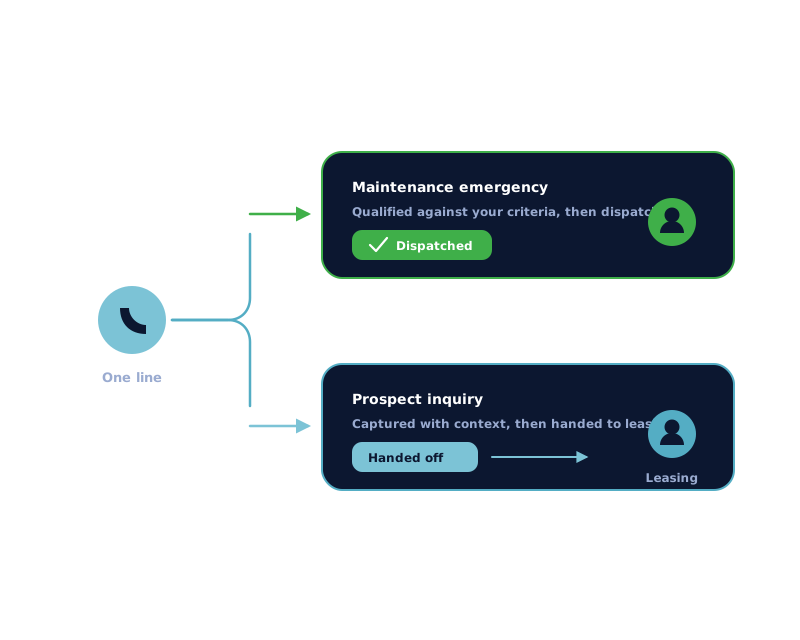
Three kinds of call, three different verdicts.
“Should AI answer the phone?” is unanswerable until you say which phone call. These three are routinely discussed as though they’re one.
The maintenance emergency
The strongest case. High stakes, but bounded. Your community defines what counts as an emergency and the system applies it consistently, at 2:00 AM, on the hundredth call of a stormy night.
The after-hours prospect
A clear win, narrowly. The alternative is voicemail, and voicemail after 6:00 PM often means the prospect calls the property down the street instead. Answering what is settled beats silence.
Daytime leasing overflow
The hardest, and the most valuable. A live team is right there, just busy. The bar is higher because the prospect could plausibly have reached a person. Done well, it hands your agents back the hours they lose to routine callbacks.
Notice the pattern: confidence drops as the conversation gets more open-ended and the human alternative gets closer. That’s the axis worth thinking along, not “is the AI good enough yet.”
Speed-to-lead is real, and it deserves a fair hearing.
This is the industry’s best case for AI on the leasing line, and it isn’t hype.
A prospect who reaches someone within minutes converts at a meaningfully higher rate than one contacted an hour later. Renters shopping for an apartment are usually calling several communities in one sitting, and the one that picks up has an advantage that no amount of follow-up fully recovers. A call that lands in voicemail at 7:00 PM is frequently just gone.
So the problem is genuine, and “we’ll return it in the morning” is a real cost. Anyone dismissing AI on the leasing line entirely is ignoring a measurable gap.
The step worth examining is the one that usually follows: because speed matters, the AI should therefore handle the lead: qualify it, quote availability, book the tour. That conclusion doesn’t follow from the premise. The value in speed-to-lead is overwhelmingly in not missing the call. Picking up in seconds, answering what you can answer accurately, and putting the prospect in front of a leasing agent quickly captures most of that value without taking on the risks in the next section.
Where AI on the leasing line actually goes wrong.
These aren’t hypothetical edge cases. They’re the predictable consequences of asking a system to improvise on questions that move.
Availability and pricing drift
Rent and availability change daily, and a confident wrong number is worse than no number. A prospect quoted a rate you can’t honor either walks at the tour or signs feeling misled.
Tours that don’t exist
Autonomous tour booking fails in both directions: a prospect who arrives to no appointment, or an agent whose calendar fills with tours that never show. Both erode trust in the system fast.
Fair housing exposure
Leasing conversations drift toward questions with real legal weight: neighborhoods, families, occupancy, accommodations. A trained agent knows to route these carefully. An improvising system may answer helpfully and create liability.
The prospect who wants a person
Signing a lease is one of the larger financial decisions most people make in a year. Some prospects want a human before they’ll commit, and an AI that can’t gracefully get them one converts an interested renter into an annoyed one.
Emergency triage has a right answer. Leasing often doesn’t.
This is the whole distinction, and it’s why we’re confident in one application and careful about the other.
An after-hours emergency call is a rules problem. Your community decides in advance what warrants waking a technician. An active leak dispatches; a running toilet waits for morning. The criteria are yours, they’re written down, and the system’s job is to apply them the same way on every call, which is precisely the kind of task automation is better at than a tired human at 3:00 AM. When it’s wrong, you can see exactly why, in the recording, and change the rule.
A leasing call is a judgment problem. What a prospect needs to hear depends on what they’re worried about, what’s actually available this week, and what your team can flex on. There’s no rubric to audit against, because the right answer wasn’t determined in advance. Automation is weakest exactly where the correct response isn’t knowable ahead of the conversation.
None of which means AI has no place on a leasing line. It means the line falls somewhere specific: answer what your community has already settled, and hand off what moves. A pet policy is settled. This week’s availability is not. Getting that boundary right is the difference between an AI that helps a prospect and one that misinforms them confidently.
Every call answered. Your leasing team’s time back.
Activ takes the routine calls off your team’s plate and hands them the ones worth their attention.
Answer Intelligence answers during business hours, after hours, weekends, and holidays. On a maintenance call it does the full job. It understands the problem in the resident’s own words, qualifies it against your community’s emergency criteria, and dispatches to the on-call technician with the unit, the details, the recording, and the transcript attached.
On a prospect call it answers what your community has already settled. Amenities, pet and parking policies, office hours, package handling, what is nearby and how to get there, all from the knowledge you configure. It listens for what the caller is actually looking for and hands that context to your leasing team, so nothing sits in a voicemail box nobody checks.
That is worth more than it first sounds. A large share of prospect calls are routine questions, and every one your team answers by callback is time not spent moving someone toward a lease. When those questions get resolved on the first ring, the time comes back to your leasing agents and goes into the work only a professional can do: the tour, the objection, the application, the follow-up that actually closes. Rent, availability, and tour scheduling stay with your team, where the live numbers are.
That is the trade we think is worth making. Every call to your community gets answered, emergencies are handled completely, prospects are genuinely helped rather than parked in voicemail, and your leasing agents spend their day on the conversations that move the pipeline. It’s the problem we’ve spent thirty years on.
Deciding between conversational AI and a menu-driven system is a separate question, covered in IVR vs. conversational AI. If you’re evaluating AI vendors of any kind, the twelve questions to ask apply to all of them.
Common questions.
- Should AI answer leasing calls?
- It depends on what you mean by “answer.” Answering a prospect’s questions about the community, its amenities, its pet and parking policies, and what is nearby, then capturing what they are looking for, is a clear win twice over: the prospect gets an answer instead of voicemail, and your leasing agents stop spending their day returning calls about the pet policy. Having an AI quote rent, confirm availability, and book tours on its own is a much larger commitment, because those three change constantly and each can be wrong in ways that cost you the lease.
- What’s the difference between AI answering for maintenance and for leasing?
- Maintenance emergencies have a right answer. Your community defines what counts as an emergency, and the system’s job is to apply that definition consistently, a bounded problem you can write down and audit. Parts of a leasing call are just as bounded: your pet policy and your parking situation do not change week to week. What is not bounded is rent, availability, and anything that commits your team’s calendar. The useful line runs between what your community has already settled and what moves.
- Is speed-to-lead a real advantage?
- Yes, and it’s the strongest argument for AI on the leasing line. Prospects contacted within minutes convert better than prospects contacted an hour later, and a call that reaches voicemail after 6:00 PM often never gets returned. The honest question isn’t whether speed matters. It’s whether you need an AI to close in order to capture that speed, or only to reliably pick up and hand off.
- Can AI answer calls during office hours too?
- Yes. Activ answers during business hours, after hours, weekends, and holidays. Daytime coverage is usually about overflow, meaning the calls that arrive while your team is already on the phone or walking a unit, rather than replacing anyone in the office.
- Does Activ book tours or quote rent?
- Answer Intelligence answers factual questions about your community from the knowledge you configure: amenities, pet and parking policies, office hours, package handling, what is nearby and how to get there. It assesses what the prospect is looking for and hands that context to your leasing team. Every routine question it resolves is a callback your agents never have to make, which is time they get back for tours and applications. Rent, availability, and tour scheduling stay with your team, where the live numbers are.